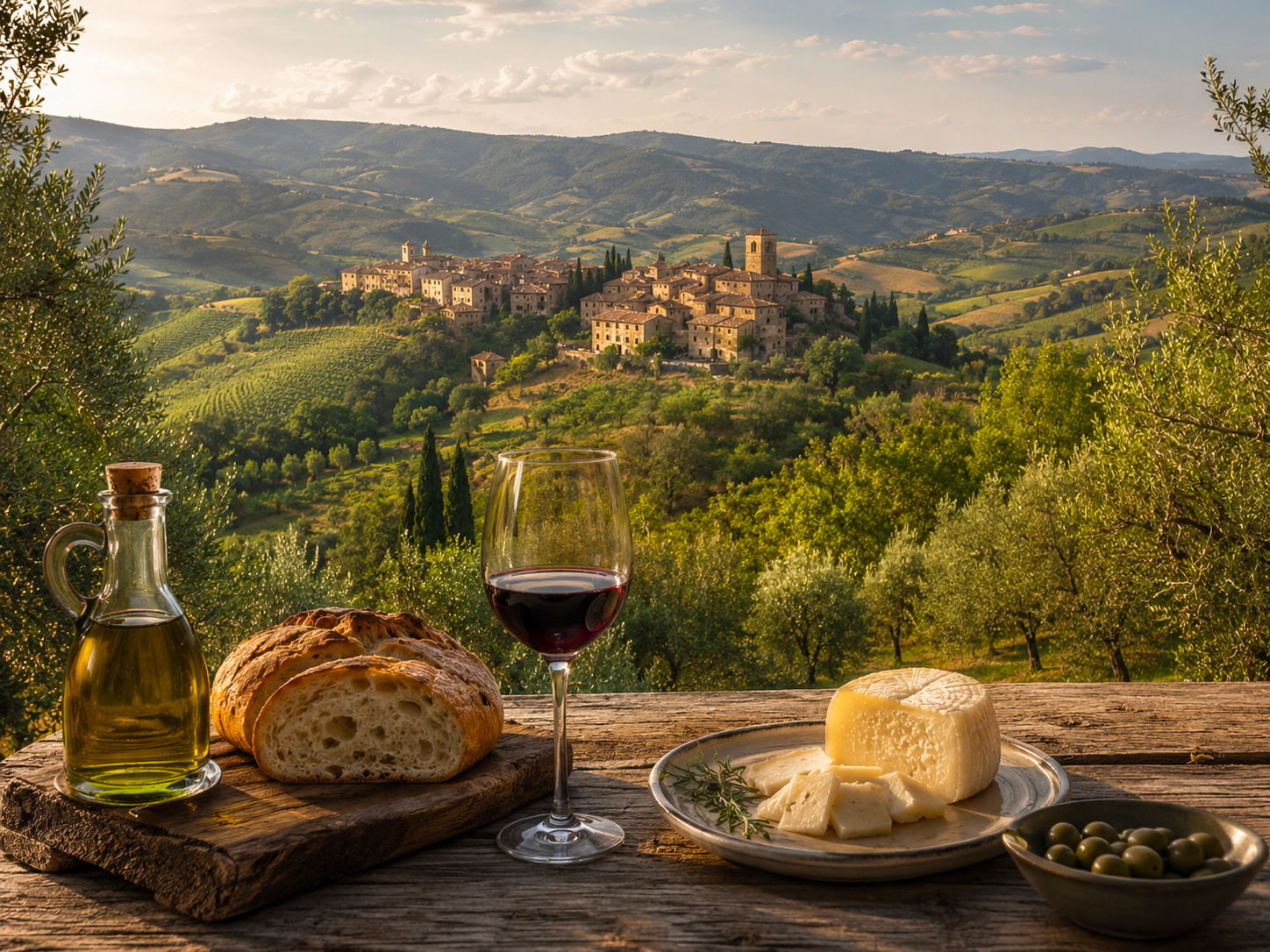
Between Arezzo, Siena, and Florence lies a less crowded Tuscany, made up of rolling hills, forests, olive groves, vineyards, and small villages that still seem to follow the natural rhythm of the seasons. This is the Valdambra, a valley crossed by the Ambra River and closely linked to the Bucine area in the Valdarno Aretino.
Discovering the Valdambra means entering a part of Tuscany that retains many of the most recognizable elements of the regional landscape without the character of the most popular tourist destinations. Here, the journey can be built slowly: a road through the hills, a medieval village, a parish church, a path through the olive groves, a stop to admire the view and, of course, the cuisine.
It’s precisely the combination of villages, landscapes, and flavors that makes this valley so captivating. Valdambra isn’t just a place to travel through on the way to more famous art cities: it can become a destination in itself for those who want to experience a rural, authentic Tuscany that’s still deeply connected to its homeland.
Where is Valdambra located?
The Valdambra extends across the western part of the province of Arezzo and takes its name from the Ambra stream, which flows through the valley before flowing into the Arno River. Its main center is Bucine, a municipality in the Valdarno Aretino, conveniently located between Arezzo, Siena, and Florence.
This geographical location has played a significant role throughout history. For centuries, the valley has been a transit area, connecting different areas of Tuscany. Etruscan and Roman remains, medieval castles, parish churches, and ancient routes speak of an area traversed by travelers, merchants, and pilgrims long before the arrival of modern roads.
Even today, this location makes the Valdambra attractive for those staying in central Tuscany. In a relatively small area, it’s possible to combine nature excursions, visits to small historic towns, and culinary delights, while staying away from the most congested tourist routes.
Bucine, gateway to the valley
Bucine is one of the natural points from which to start discovering Valdambra. The village has medieval origins and retains traces of its fortified structure, but it is above all the territory that surrounds it that explains the identity of the valley.
Leaving the town, the landscape changes rapidly. The roads wind through cultivated hills, rows of vines, olive groves, fields, and wooded areas. Small hamlets and historic centers appear along routes that invite detours rather than rushing.
This is an important characteristic of the Valdambra: there isn’t necessarily a single monument around which to build the entire visit. The experience is instead shaped by the succession of places, the secondary roads, the views, and the opportunity to traverse the territory at a more leisurely pace.
In this sense, Bucine represents a form of tourism linked to the concept of slow travel: stopping, walking, observing, and building your own itinerary without turning each stop into something to be consumed quickly.
The villages of Valdambra to encounter along the journey
One of the most fascinating aspects of the Valdambra is the presence of numerous small historic towns scattered across the hills and along ancient communication routes. Some are very small, but this very characteristic allows one to still perceive the original connection between the villages and the landscape.
Badia Agnano, for example, retains a compact medieval structure and is one of the most recognizable places in the valley. The village grew up around the ancient abbey and maintains the secluded atmosphere that characterizes many settlements in rural Tuscany.
Capannole is another important site in the Valdambra. Nearby, Roman remains have been discovered, a sign of the area’s long history. Today, Capannole is also home to Antico Portale, nestled in the greenery of the valley.
Continuing in the territory you come across places such as Cennina, Montebenichi, Rapale, Sogna, Pogi and San Leolino. You don’t necessarily need to build a day with the aim of visiting them all. The most interesting way to get to know this part of Tuscany is often to choose a few points and leave room for detours, panoramic roads and unexpected stops.
Montebenichi and the roads of the hills
Among the small towns in the area, Montebenichi offers one of the most evocative examples of the relationship between historic settlement and landscape. It stands in an elevated position and retains the character of an ancient fortified village.
Getting there means crossing a part of the Valdambra where cypress trees, olive trees, and woods line the route. It’s precisely during these journeys that the journey takes on meaning: the road isn’t simply the stretch necessary to reach the destination, but becomes part of the experience.
The valley’s shape allows for vastly different landscapes to be observed within a few kilometers. Cultivated areas alternate with woods and ridges, while from higher elevations, the view opens up to the Valdarno and the other hills of central Tuscany.
Pogi and the historical relationship with the Valdarno
Near Pogi, the landscape clearly illustrates the connection between the Valdambra and Valdarno valleys. One of the area’s most famous features is the ancient bridge, remodeled over the centuries, a reminder of how important these roads were for travel.
From here, trails also depart through oak and holm oak trees, broom bushes, and olive groves, reaching panoramic viewpoints overlooking the Upper Valdarno. This area is particularly suited to exploring on foot, as many details would be lost if viewed only from a car window.
Walking through the Valdambra allows you to recognize the structure of the landscape: the crops follow the slopes, the villages occupy strategic positions and the ancient religious or defensive buildings often appear where the geography itself suggests their presence.
A valley to be traveled slowly
The network of rural roads and trails is one of the elements that make the Valdambra attractive for those who love walking or cycling. In the Bucine area, several itineraries have been developed that connect villages, natural areas, historic buildings, and panoramic viewpoints.
Among these are trails that cross the countryside around Bucine, itineraries through vineyards and olive groves, and paths that connect several small villages. The landscape also changes dramatically with the seasons: the green of spring, the fields of summer, the warmer colors of autumn, and the essential atmosphere of winter offer different interpretations of the same territory.
This is a particularly fitting way to visit the valley. There’s no need to pile up attractions here. A half-day can be built simply by choosing a hike, visiting a village, and dedicating the rest of the time to dining.
Vineyards and olive groves: the landscape that becomes flavor
In Valdambra, the agricultural landscape isn’t just a backdrop. Vineyards and olive groves are part of the area’s economic and gastronomic history and contribute to the image of the Tuscan countryside, which still retains a productive dimension here.
Extra virgin olive oil is one of the fundamental ingredients of local cuisine. It’s used in dishes, paired with bread, complementing soups and vegetables, and represents one of the most immediate connections between landscape and food.
Viticulture also plays an important role. Vineyards line many of the area’s roads and help establish Valdambra as part of the broader winemaking mosaic of central Tuscany. Visiting this valley, therefore, means understanding that many of the elements observed during a stroll return, transformed, in the glass and on the plate.
The flavors of Valdambra and the province of Arezzo
The local cuisine is part of the great tradition of Tuscan cuisine, but has particularly strong ties to the Arezzo area. Bread, oil, vegetables, legumes, cheeses, cured meats, and meats form the basis of a cuisine largely inspired by rural life.
Black crostini, dishes made with stale bread, slow-cooked ragùs, fresh pasta, and meat dishes all tell the story of a culture in which the value of a dish stemmed primarily from the ability to make the most of what the land had to offer.
The proximity to Valdarno and the other Arezzo valleys further expands this gastronomic heritage. Chianina, Tuscan cured meats and cheeses, seasonal vegetables and oil become elements of a culinary language that can be proposed in a traditional way or interpreted through a more contemporary sensitivity.
Tradition and contemporary cuisine can tell the same story of the same territory
Traveling through the Valdambra allows us to understand why talking about local cuisine doesn’t necessarily mean always reproducing the same recipes. A region can be described through ingredients, techniques, memories, and seasonality, even when the end result takes on new forms.
This is the idea behind the cuisine at Antico Portale, in Capannole di Bucine. The restaurant is located inside a Tuscan farmhouse surrounded by greenery and interprets the local area through contemporary Tuscan cuisine, where regional roots are the starting point, not a limit.
The menu changes with the seasons and the availability of ingredients. Homemade bread and pastries, fresh pasta, meats, Tuscan products, and traditional recipes can therefore coexist with more modern techniques and combinations.
This approach is particularly consistent with the location: observing the countryside, passing through olive groves and small villages during the day, and finding some of those same elements in a different form at dinner allows for an experience where landscape and gastronomy are not two separate moments.
An itinerary between Valdambra and the table
A day in Valdambra can be organized without overly rigid schedules. You can start from Bucine, follow one of the roads that lead into the countryside, and choose one or two villages to visit. Badia Agnano, Montebenichi, Pogi, or other small centers in the area can become stops on a route built primarily around the landscape.
Those who prefer walking can spend a few hours on one of the local itineraries; those traveling by car can instead alternate short drives with scenic stops. In both cases, it is worth avoiding turning the day into a race between locations.
In the late afternoon, the pace can change again. The light on the hills, an aperitif, and subsequently dinner become the natural continuation of what was observed during the day. This is also one of the most interesting ways to get to know Tuscany: not only through monuments and museums, but by creating a dialogue between landscape, history, and cuisine.
Valdambra, a Tuscany that invites you to linger
Valdambra does not need to compete with the region’s major destinations. Its value lies precisely in a different scale: small villages instead of large centers, country roads instead of congested routes, parish churches and castles immersed in the landscape, vineyards, olive groves, and a gastronomy that continues to maintain a direct relationship with the land.
It is an area suitable for those seeking a Tuscany to be observed slowly, dedicating time to short distances and details. Bucine and the surrounding villages allow for various itineraries, while the position between Arezzo, Siena, and Florence makes the valley interesting as a stop within a broader journey.
But it is above all by stopping that Valdambra reveals its character. Walking along a path, looking out over the Valdarno, passing through a small village, recognizing the olive trees on the hills, and ending the day with a cuisine capable of interpreting those places means transforming a simple visit into an experience of the territory.
Because some parts of Tuscany do not ask to be simply seen. They ask for time, curiosity, and a willingness to be guided by the landscape all the way to the table.